Olivier Terrier participera au prochain colloque dédié au COVID-19 organisé conjointement par l’ANR et l’ANRS-MIE.
A cette occasion, à la demande l’ANR, il interviendra pour faire un résumé prospectif basé sur le questionnaire envoyé aux porteurs de projets financés par l’ANR sur la période 2020-2022, dans les domaines de la détection, du diagnostic, de l’aerolisation et des approches prophylactiques et thérapeutiques.
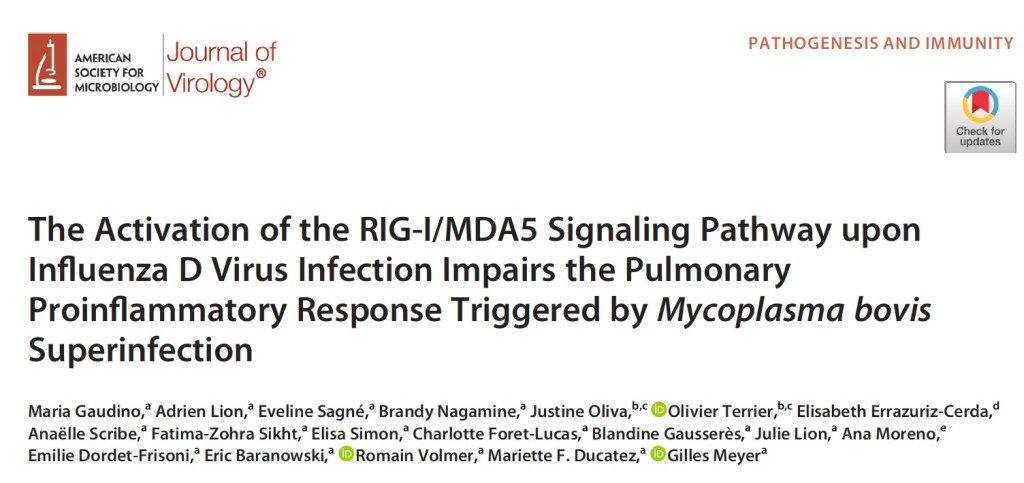
We are very pleased to have collaborated on the thesis work of Maria Gaudino, (Mariette Ducatez/Gilles Meyer – IHAP, University of Toulouse, INRAE, ENVT, Toulouse, France), which has been published today in Journal of Virology.
Our collaborators have used the organotypic lung model precision-cut lung slices to study the interplay between IDV and M. bovis coinfection. The results obtained show that a primary IDV infection promotes M. bovis superinfection by increasing the bacterial replication and the ultrastructural damages in lung pneumocytes. Interestingly, IDV impaired the innate immune response triggered by M. bovis by decreasing the expression of several pro-inflammatory cytokines and chemokines that are important for immune cell recruitment and the bacterial clearance.
These results highlight previously undescribed innate immune mechanisms in cattle and improve our understanding of host-microbe interactions and the contribution of influenza D viruses to pathogenesis.
At the end of this year, we are very happy to welcome three new PhD students to our group, in the context of new exciting projects and collaborations.
Kylian Trepat will study the alterations of the antiviral innate immune response in severe respiratory infections. The project will focus on the role of autoantibodies in the context of viral co-infections. This doctoral work, co-directed by Sophie Trouillet-Assant and Olivier Terrier, is being carried out in collaboration with the joint HCL-BioMérieux laboratory (MESRI grant).
Charles Terra will study the impact of SARS-CoV-2 and other types of viral infections on the metabolism of lung epithelium cells. Our knowledge of the interplay between SARS-CoV-2 and cell metabolism is still limited and may reveal potential biomarkers that could improve the early diagnosis of the most severe forms of COVID-19. This work is part of a collaboration between our group and the TIMC/CHU Grenoble Alpes laboratory and will be co-directed by Audrey Le Gouellec and Olivier Terrier. The project is supported by Fondation Air-Liquide.
Aurélien Gibeaud will study the modeling of viral co-infections in the epithelium, as part of a Franco-German collaborative project funded by the ANR-DFG (MORIARTY Project). This project will combine different in vitro and in vivo experimental approaches with mathematical modeling tools, in order to better understand the interactions between viruses but also treatments in this context.
Modelling of viral respiratory co-infection dynamics (closed)
A PhD position is available in the VirPath team (CIRI, Lyon, France), to study viral co-infections in the respiratory tract.
This PhD position is part of a Franco-German project funded by ANR-DFG (MORIARTY) whose objective is to combine experimental approaches with novel analytical methods and mathematical modelling to (i) decipher viral replication dynamics of four main respiratory viruses of various severity, (ii) evaluate how co-infection modulate the individual viral dynamics, (iii) anticipate the efficacy of antiviral treatments, and (iv) understand the impact of co-infections on virulence and transmissibility in the population.
The PhD project will focus on the in vitro and in vivo experimental part of the program, using human rhinovirus (HRV) and Respiratory Syncytial Virus (RSV) as models of seasonal viruses, and on influenza A viruses (IAV) and SARS-CoV-2 as models of pandemic viruses. We will work with reconstituted human airway epithelium and different animal models relying on immunohistochemical imaging and time course infection measurements to assess cell-type specific infectivity, viral replication kinetics, and innate immunity under physiological relevant conditions.
This Phd position is opened starting in January 2023
This position will take place in the Centre International de Recherche en Infectiologie (CIRI, http://ciri.inserm.fr) in the VirPath team (Prof Bruno Lina/Dr Manuel Rosa-Calatrava). The project will be carried out within the group led by Dr Olivier Terrier, whose research theme is dedicated to the study of respiratory co-infections (https://olivierterrier.fr).
The CIRI is a highly dynamic environment fostering interactions between virologists, bacteriologists, immunologists and clinicians and providing all the necessary platforms and facilities for the project. The VirPath team is very dynamic and involved in numerous collaborative projects with academia and industry.
Candidates: We are looking for highly motivated and enthusiastic candidates, who likes teamwork, with good communication skills.
Application: Candidates are invited to contact Olivier Terrier (olivier.terrier@univ-lyon1.fr) for further details. Please send an application including a cover letter and a curriculum vitae.
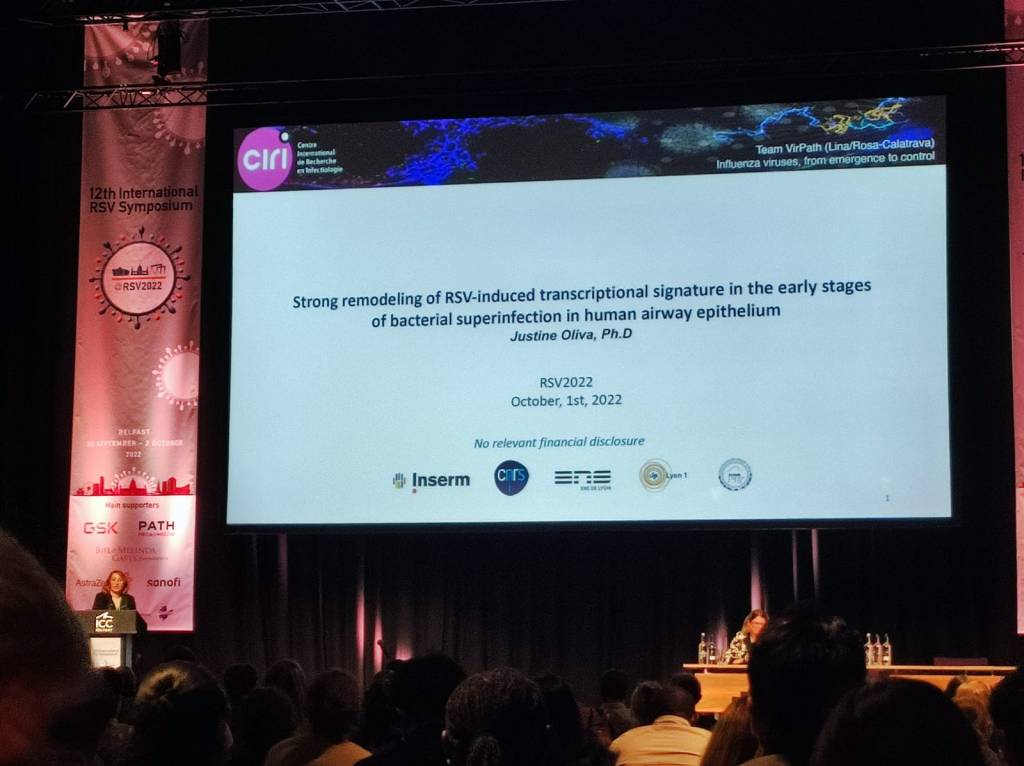
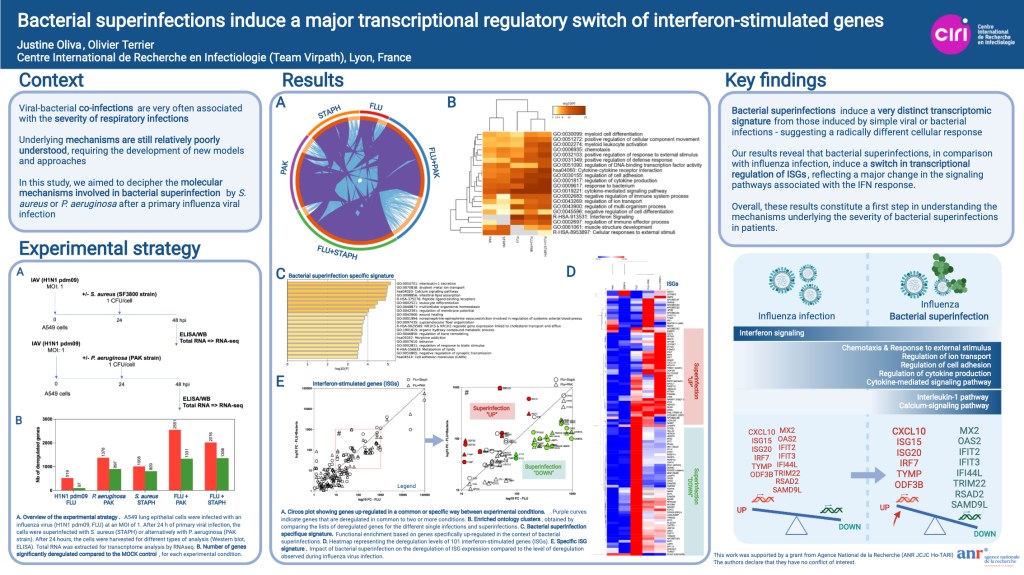
Justine Oliva will give a talk entitled “strong remodeling of RSV-induced transcriptional signature in the early stages of bacterial superinfection in human airway epithelium”, Sat 1/10 15h45. Do not hesitate to discuss with Justine about this great ongoing project focused on RSV/Bacteria co-infection (and other projects we are working on, of course!)
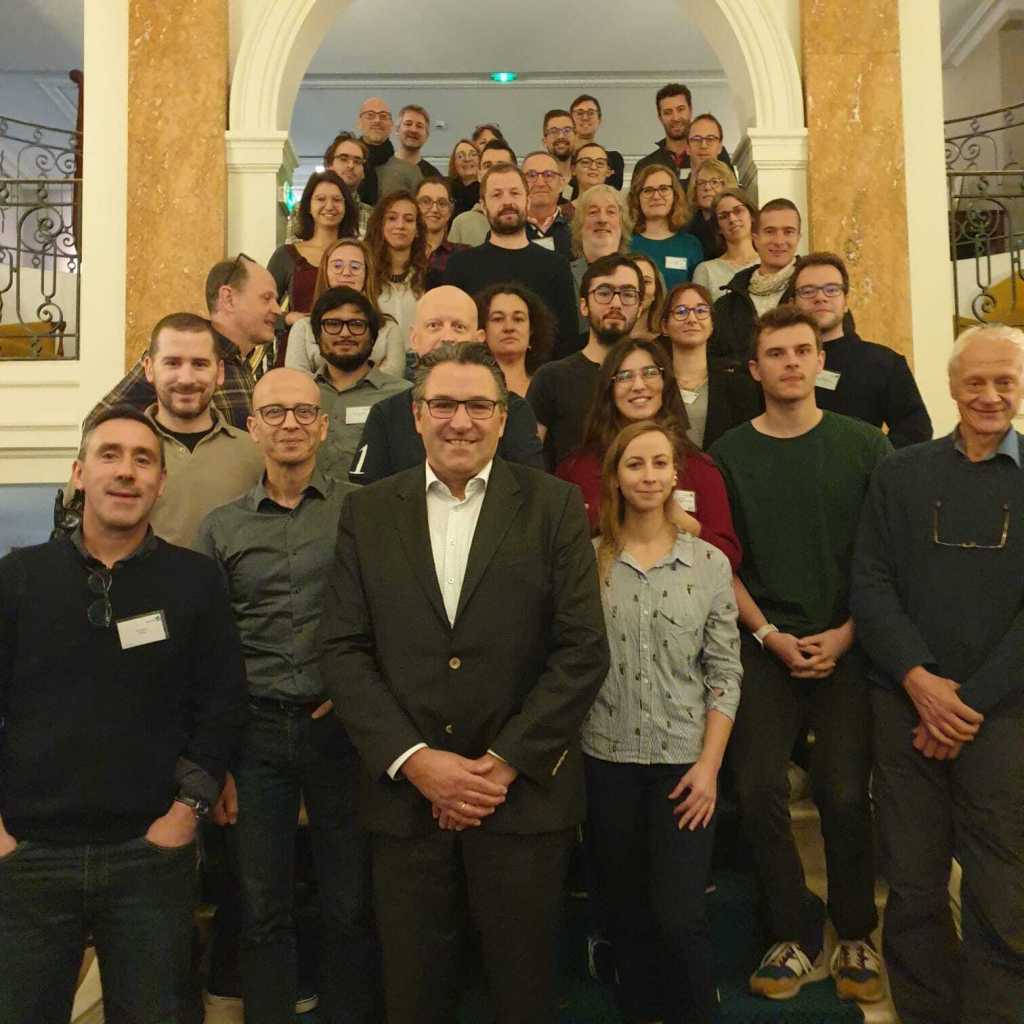
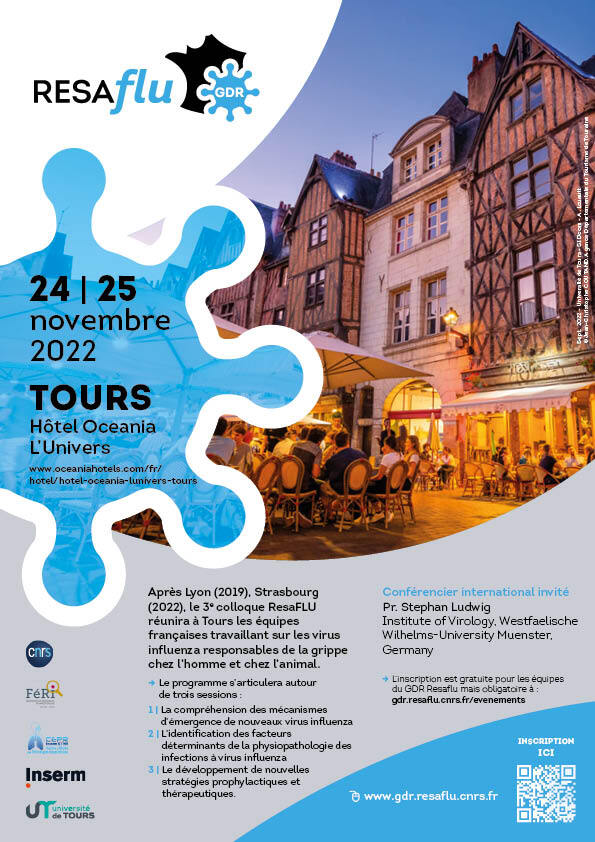
Après Lyon et Strasbourg, les prochaines journées du GDR RESAflu (GDR CNRS 2073) se sont étalées sur deux demi-journées les 24 et 25 Novembre à Tours (Hôtel Oceania L’Univers). Ce groupement de recherche fédère les équipes françaises travaillant sur les virus influenza responsables de la grippe chez l’homme et chez l’animal.
Les axes de recherche développés au sein du réseau ont été représentés au cours de 3 sessions:
1 – Compréhension des mécanismes d’émergence de nouveaux virus influenza
2 – Identification des facteurs déterminants de la physiopathologie des infections à virus influenza
3 – Développement de nouvelles stratégies prophylactiques et thérapeutiques
Very happy about this exciting collaboration with Loïc Guillot’s group (CRSA Sorbonne Université).
In this study published in Frontiers in Immunology, we show that Pseudomonas flagellin increases TMPRSS2 expression, especially in the context of cystic fibrosis, via activation of TLR-5 and p38 MAPK, resulting in increased SARS-CoV-2 infectivity.
Further clinical follow-up studies and in vitro experimental investigations into the mechanisms associated with the specific host response of primary CF cells to SARS-CoV-2 infection should help elucidate this matter and provide insights for future clinical care. Work in progress!
Schematic illustrating the results of the study. P. aeruginosa interacts with the airway epithelial cells of pwCF, notably by activating the TLR5 signaling pathway through its virulence factor, flagellin. This activation, dependent on p38 MAPK and NF-kB, leads to an increase in TMPRSS2 which could regulate SARS-CoV-2 infectivity.



 Respiratory coinfections