Author: Olivier Terrier
RCF Lyon Radio interview
https://www.rcf.fr/economie-et-societe/dis-pourquoi-rcf-lyon?episode=462241
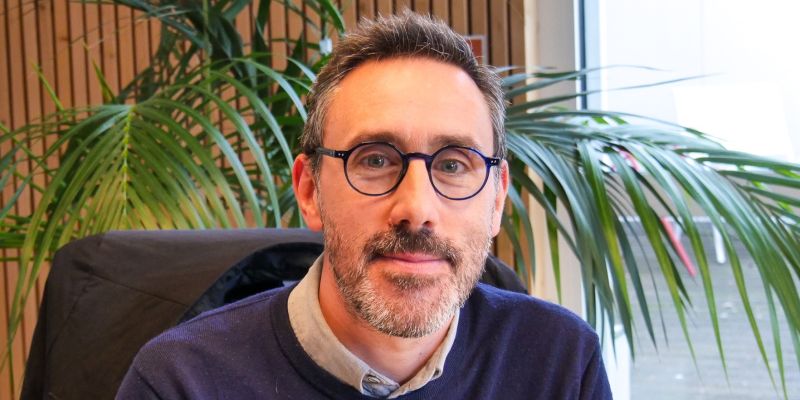
Olivier Terrier, chercheur CNRS au Centre International de Recherche en Infectiologie à Lyon, est l’un des contributeurs d’un ouvrage qui vient d’être publié avec le CNRS aux éditions Cherche Midi : L’ère des pandémies : Covid, les avancées de la recherche. Retour sur le chemin parcouru par les scientifiques depuis l’apparition du covid il y a quatre ans.
9th International Influenza Meeting – Registration & Abstract Submission open!
Dear friends and colleagues,
Dear ladies and gentlemen,
Today we would like to inform you that the Registration and Abstract Submission of our upcoming „9th International Influenza Meeting“, which will take place from 05 – 07 September 2024 in Münster, Germany, are open!
The 9th edition of this meeting will take place under the topic “from bedside to bedside”, bridging the gap from theoretical research to application. The meeting is being organized together with our colleagues from the French ResaFlu network in order to emphasize the aspect of internationality at the organizational level as well. The 9th International Influenza Meeting will feature an exciting programme with reports about new developments in the field of Influenza. We will provide a challenging scientific programme with plenary lectures and keynotes by invited speakers and selected oral and poster presentations.
The meeting offers a good opportunity to exchange new data and aspects of influenza research with scientists from Germany, France, Europe and all over the world.
Your colleagues
Gülsah Gabriel (Hamburg l Germany
Hiroki Kato (Bonn l Germany)
Nadia Naffakh (Paris l France)
Colin Russell (Amsterdam l The Netherlands)
Olivier Terrier (Lyon l France)
Richard Webby (Memphis l USA)
already confirmed their attendances and will present most recent data of their research area.
Other Meeting topics will be basic research regarding Influenza organized under the following categories:
Antivirals and Vaccines
Co-Infection
Evolution and Emerging Viruses
Host Cell Interaction
Immune Response
Viral Pathogenesis
Virus Replication
We are very pleased to hold the meeting in person in the stunning venue of our university’s castle. Besides lectures and poster discussions we will reserve ample time for discussions with food and drinks in a relaxed atmosphere.
Abstract submission
Abstracts are welcome for oral and poster presentations on the topics mentioned above. Please submit your abstract online here: https://evis.events/event/399/abstracts/
Registration
Please register online here: https://evis.events/event/399/registrations/
Conference fee
Regular rate (postdocs and senior scientists):
€ 130
Reduced rate* (undergraduate students, graduate students, PhD students):
€ 80
*Confirmation required onsite
Key data of the 9th International Influenza Meeting
Date: September 05 – 07, 2024
Venue: University of Muenster, Germany
You will find all upcoming information regarding the meeting online here: https://www.medizin.uni-muenster.de/fluresearchnet/events/9th-international-influenza-meeting.html
or here: https://evis.events/event/399/
If you have any questions about the meeting or Muenster, feel free to contact us anytime via
fluresearchnet@uni-muenster.de
Or write Sebastian via
Sebastian.Sprengel@ukmuenster.de
We are looking forward to welcoming you in Münster soon!
Feel free to share this mail and the attached Save-the-Date Card with other potentially interested persons!
With kind regards,
on behalf of the Organizing Committee
COVID-19, the natural history of a disease. What does science have to say about the risks of a new epidemic era?
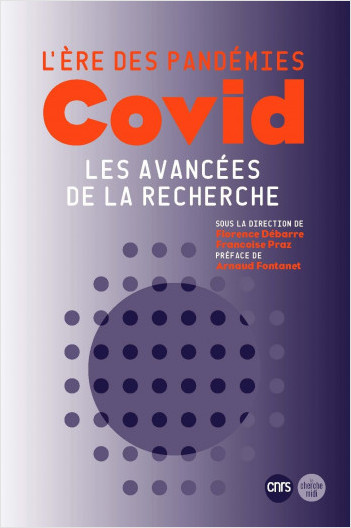
Release today of a collective work dedicated to COVID-19, published by Le Cherche Midi, in which I had the pleasure of contributing.
Has the world entered a new epidemic era? What does science have to say? For several years now, scientists have been warning of the emergence of new diseases and the influence of environmental and social factors on health.
COVID-19 and the health crisis it provoked have precipitated a new awareness of the dangers posed to humanity by viruses, coronaviruses and other variants. In this book, researchers, physicians, biologists and epidemiologists set out to tell the “natural history of this disease”: to recount its pandemic history and the questions it has raised, to understand viruses and coronaviruses, their differences, their location, their modes of transmission and the risks of crossing species, to take stock of the mechanisms of infection, replication and the notions of mutation and recombination. Beyond the polemics, the book takes stock of advances in research into this type of disease, as well as vaccination to protect against it. An essential review of a pandemic that has often been treated more on its medical and health aspects than on its scientific ones. This is a major contribution by scientists to the general public, enabling us today to better measure the risks of this new pandemic era, and to provide keys to protection against it.
Le Cherche Midi Publisher, produced with the CNRS, the Institut écologie et environnement (INEE) and the Institut national des sciences biologiques (INSB). Collective work edited by Florence Débarre, Agnès Mignot, Serge Morand, Françoise Praz. Foreword by Arnaud Fontanet
Journal Club – Saliva/diagnostic & Innate Immune memory

At our last journal club (8 December 2023), we discussed two very interesting manuscripts: One concerns the determination of a ‘core’ signature specific to a viral infection and its exploitation in a diagnostic approach in the saliva of patients (Yang et al. mBio 2023), the second concerns antiviral innate immune memory in macrophages following infection by SARS-COV-2 (Lercher et al. BioRxiv, 2023). The programme therefore includes plenty of ‘omics’ as well as virus/virus confection!
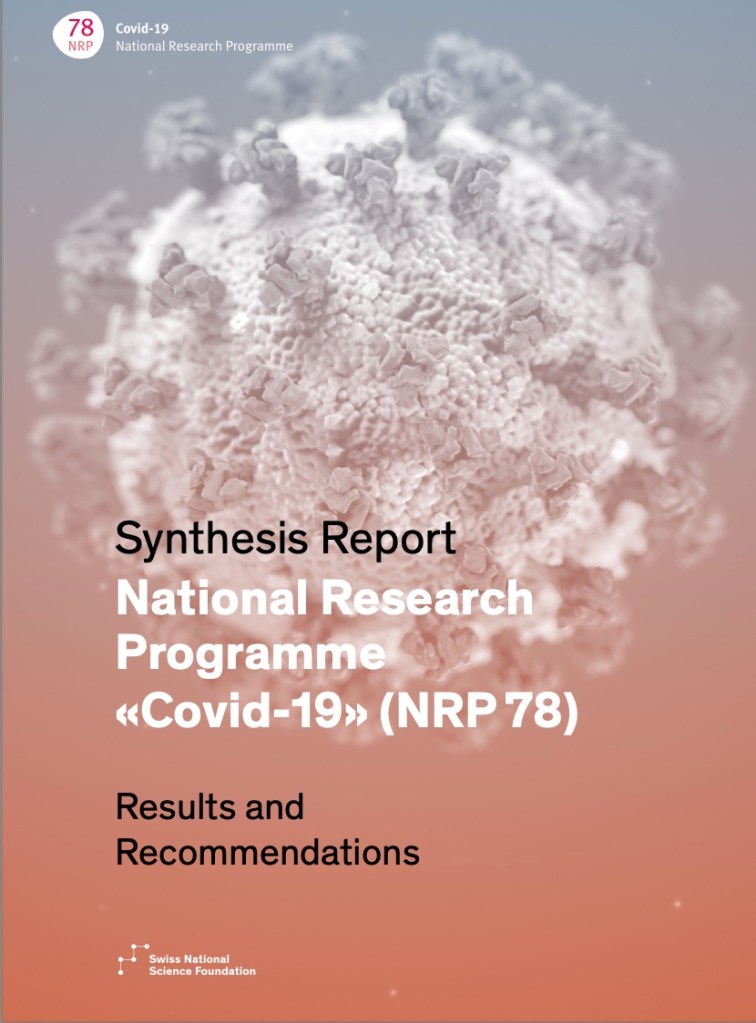
Synthesis Report of the National Research Programme “Covid-19” (NRP 78)
For the past three years, I had the privilege of being part of the Steering Committee of the National Research Programme “Covid-19” (NRP78) of SNSF Swiss National Science Foundation, whose summary report is published today. It has been a fascinating experience, and I’ve thoroughly enjoyed working with the NRP78 team under the guidance of Marcel Salathé.
I learnt a lot, and I really enjoyed being able to follow the progress of the different NRP78 projects. I would like to congratulate all the research teams involved in this programme, who have carried out high-quality work and contributed to a better understanding of SARS-CoV-2 and COVID-19.
If you would like to learn more about this programme’s results in terms of recommendations and scientific output, do not hesitate to consult the synthesis report.
Poster: overview of three ongoing PhD projects in the group
A tale of three neuraminidases
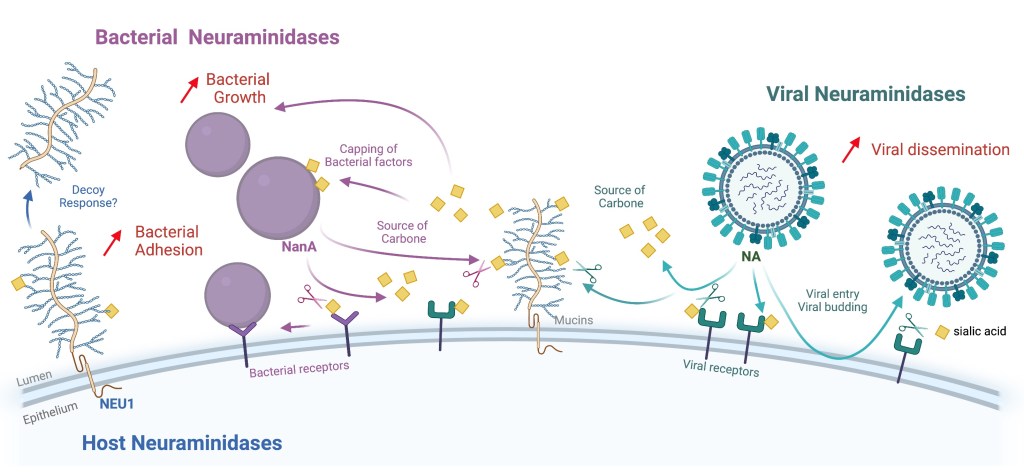
The activity of sialic acids, known to play critical roles in biology and many pathological processes, is finely regulated by a class of enzymes called sialidases, also known as neuraminidases. These are present in mammals and many other biological systems, such as viruses and bacteria.
In a review just accepted for publication in Frontiers In Microbiology, we focused on co-infections at the level of the respiratory epithelium, the scene of multiple functional interactions between host, viral and bacterial neuraminidases. This topic illustrates the complexity of respiratory co-infections that need to be further explored through multidisciplinary approaches. Strategies targeting or mimicking the activity of neuraminidases could be a very interesting avenue for the development of treatments for bacterial superinfections.
Reference: Escuret V, Terrier O. Co-infection of the respiratory epithelium, scene of complex functional interactions between viral, bacterial, and human neuraminidases. Front Microbiol. 2023;14. doi: 10.3389/fmicb.2023.1137336.
Our work on SARS-CoV-2 presented at Cell Symposium: Viruses in Health and Diseases (Sitges, Spain)

Our collaborator, Loïc Guillot (CRSA Saint-Antoine) will present our work on the characterisation of SARS-CoV-2 in different physiological-pathological contexts (CF, COPD) “Divergent molecular responses of bronchial epithelium to SARS-CoV-2 infection in relation to pre-existing respiratory disease state”.
Kylian Trepat will present a poster presenting the work he participated in during his Master 2, under the supervision of Sophie Assant ” Comparison of immunogenicity and protection in HCWs primed with ChAdOx-1-S or BNT162b2 after one or two doses of mRNA booster”
ResaFlu/FluResearchNet joint symposium, 4-6 October, Lyon
Save the date!
Dear colleagues,
We are pleased to announce that we will organize, in partnership with the German network FluResearchNet, a joint symposium, from 4 to 6 October, in Lyon. This symposium, whose program is under preparation, will be an opportunity to exchange on the different topics related to human and animal influenza viruses in a friendly atmosphere. A call for abstracts will be issued soon, we count on you!
 Respiratory coinfections